Monday, February 29, 2016

16 month update

We're a few days early on this, but I wanted to get some additional information down that I forgot to post at the 1-year update concerning scapular stability. I was working on this primarily in my second go-round of therapy during months 8-12 post-surgery when I started having elbow pain following my premature exit from initial therapy. As it turns out the scapular control has been really great for my throws during Ultimate, especially the backhand. This is timely as Jonah Wisch, a former team mate, just posted an article talking about this very topic.

Before I get into it, I just wanted to give an update on my condition. The shoulder feels really good. I can barely tell I had the surgery anymore other than the scar and a few awkward overhead arm positions where I still have some minor stiffness/weakness. Interestingly enough, I was really scared to get back into climbing, especially after the elbow problems from this past late summer/early fall, but as it turns out, getting back to climbing was the best therapy I could've done. There are so many dynamic aspects to climbing involving not just the grip and forearms, but moreover the shoulders and back muscles. Things that I really had a hard time training statically/during therapy. I started climbing again full time right after the new year, and now, two months later I see a huge increase in strength and range of motion. I'm thrilled with where I am, physically in that regard. I'd say I'm beyond 95% ROM, and in some ways I am better than I was before the surgery because 1) my tendons aren't ruptured anymore, and 2) I have much better scapular control, which of course is the focus of today's post.

Details on the therapy are found in earlier posts, but there are the actual therapeutic procedures and exercises I did to deal with my scapular control issues, elbow pain, and shoulder hypermobility.

-Prone horizontal abduction on physio ball, 3x10


-Wall walks/slides, x15 (can be done w/theraband connecting both wrists)


-1/2 foam roller (balance) quadruped ball roll, 3x30s
See image: can do this with just one half-foam under knees, adding the one under hands makes it harder. Image shows arm extensions, but can be done pushing/batting  ~8lb medicine ball around on floor next to support arm/under shoulder


-1/2 foam roller (balance) frisbee backhand (mimic throwing motiona w/o releasing), x30
Stand on half foam as shown in image, or switching feet parallel to length of 1/2 foam. Go through throwing motions with frisbee. Can work on actual throws/catches if you have a partner.


-Foam + CLX band resisted frisbee backhand (CLX band attached to arm/shoulder and anchored to stationary object i.e. squat rack), x40
See image: For using a disc, just change angle of arm/attachment to adjust for backhands.


-Side laying, solo one-handed (external rotation), 1lb ball toss, external rotation, x30
This can also be done, as this video shows, as a dumbbell lift
See image: Replace dumbell with small 1-2lb medicine ball and do quick short self throw/catches using same hand-position/range-of-motion shown, here.

Upper panel image

Lower panel image

-Side laying, partner toss one-handed (over-handed), 1lb ball toss/throw, x30
^Same as above side-laying exercise but have partner stand ~5-10 feet away and underhand toss medicine ball, which you catch in the position from lower panel image and throw back. Stabilize with scapula!

-Sustained dumbbell scaption, balance on 1/2 foam, x20

-1/2 foam 'statue of liberty' w/red theraband flex bar, 4x30s


-1/2 foam quadruped 'thread the needle', x20 (Video shows motion, but try it weighted pulling on cable machine)
Alternate video, added difficulty from side plank: thread the needle', 20lbs x20


-Standing external rotation w/theraband, 3x20
I prefer the "no money" variation, which forces each side to pull equally.


-CLX band plank walk/crawl, 3-5 steps in each direction x3
Couldn't find the perfect photo/video, but it can be done similar to the resisted bear crawls (sorry for the music). CLX bands have infinite applications and are easy to travel with. Awesome when you're on the go, or traveling to tournaments.

These two images are both showing great exercise variations. The first one, instead of done standing, but in a plank position and walking sideways (crab walk) or forward/backward similar to the resisted bear crawl video is awesome and VERY tiring.


-Standing ball dribble off wall at 90degrees/90degrees (elbow/shoulder), 3x30s
Make sure to keep that angle at 90 degrees both at the armpit and elbow!


Many of these exercises can be made harder/easier by removing/adding a balance ball, bosu ball, half-foam, or standing on a single leg, attaching a resistance band, etc.

This may be my last update so thank you for hanging around and checking everything out of the last 16 months. The shoulder feels great. Now I just need to figure out this lower lumbar/spine issue. Appointment on March 8th. Fingers crossed for a no-surgery solution!

Wednesday, November 4, 2015

What change a year can make

Hard to believe I am 365 days removed from surgery. At this time a year ago I was trying to struggling to eat dinner, my nerve blocker had not worked off, so I couldn't feel my fingers in my right hand, and I was woozy from the anesthesia. That night was one of the worst of my life, particularly the gap between surgery pain killers and the oral opioids that had not kicked in, yet. The following weeks were no easier.

My last entry was four months post surgery, in early March. I was released from physical therapy rather quickly to home exercises. It turned out to be a mistake. What most of you do not know is that in the months following I did continue to make progress in strength and range of motion, but most of my technique was sub par. I was compensating with my trap for my scapular controllers. My supraspinatus still wasn't firing correctly. As a result I started putting more strain on my triceps and developed bad elbow pain that I initially thought was some sort of lateral or medial epicondylitis (golfers or tennis elbow). By the 4th of July I could barely throw a backhand without terrible sharp pain. I was terrified I had torn something in my elbow because of compensation issues. I had to do something about it, or risk long-term health issues, and ruining my Club Ultimate season. On July 16th I went back to physical therapy.

Though I tried to return to the same office that was involved in my procedure, they made it difficult to do so based on their silly policies and lack of available appointments. I went to a different office that took me almost immediately. Physiotherapy Associates (Rockville office) has taken incredibly good care of me in the past nearly four months. From the front desk (Cindy), to the therapy assistants (Erika and Brian), to my therapist (Anastasia Rukavyshnykova, yes, Nastia, I did it without checking your business card), I received nothing but the highest standard of care, met with a willingness to work with me closely, and a true empathy for my situation.

I will post a scanned image of all the exercises I have been doing in the past four months, but until then I simply want to share the diagnosis. Turns out I have substantial joint hypermobility, including at the elbow. Essentially, I am able to extend knees/elbows beyond 180 degrees, I can bend my fingers back to abnormal degrees, etc. As a result of this, and combined with substantial weakness in the external rotation of my shoulder the problem with my elbow developed. With external rotation of the shoulder, primary muscles involved are teres minor, deltoid, and infraspinatus, that later of which was the other tendon that was (50%) torn. Scapular control (muscles in the mid/upper back around the spine) is also incredibly important to stabilize many shoulder motions, and this was one of the muscle groups most affected by atrophy during the 6 weeks of non-use post-surgery.

At my four month update I wrote that I thought I was close despite the average recovery time taking about one year. I laughed when I looked back and read that. I set high standards for myself, but I also really believed that I was close. I never appreciated just how complex the shoulder is, nor did I understand how severe the initial damage in my shoulder was, or the fact that the tendons probably were torn and getting worse for the better part of two years before the surgery. The weeks of immobility and passive motion post-op were a big delay and not only was I not getting stronger during this time, but I was getting weaker from non use.  When you consider all these things and add on my hypermobility, plus my quick return to Ultimate and lifting, it is much less surprising what happened to me in July.

So where am I now? For real? I hesitate to say "close", as I did with folly 8 months ago, but I'm in much better shape now. I have more strength and range of motion in all directions. Everything I do now is easier. I think about my shoulder less, though it is still a constant presence in my day-to-day life. The work I did with Anastasia has been remarkably effective, though. The elbow pain went away within a few visit. My strength, particularly external rotation, is finally improving as I stay as diligent as possible with my at home therapy. My scapula on the right side actually feels like it is activating, when I felt like I could not will it to 'go' for months after the surgery. It feels like a real muscle again! More great news is I'm back to lifting heavy. Last week I hit 205# on my squat and 365# on my deadlift for the first time since my surgery. Most importantly I can bench press (flat and incline) safely, comfortably, and without and searing pain in my shoulder. My next goal is to hit 1000# on these combined lifts. Ultimate is good, too. My pulls and deep throws feel good. The mechanics on my hammer are returning. I have not returned to climbing, and I'm not sure when I will, but that is currently less pressing that making sure everything with my shoulder and elbow is totally fine. For now, everything is moving forward, and I feel good about that.

The plan going forward to is to keep working hard; remaining diligent; remaining mentally tough. I had a lot of moments of psychological and emotional struggle in the past year. There were many times that no one is aware of, until the moment I publish this blog post, where I completely broke down. It always happened during a shoulder workout. I would be stretching in the doorway, working on front raises, or my scapular control, and looking in the mirror I could see my form was awful. I would get frustrated. "It's nearly a year since my surgery, why can't I do this? What is wrong with me? Will I ever be ok?". I'd feel my elbow pain come and go, occasionally. I would often feel completely helpless. I would hang my head, or even lay no the ground in a crumpled mass of frustration and cry.

So, this year was hard. While I wouldn't wish this experience on anyone for many reasons, I can appreciate the character building that has come from my struggles, and I am sure in the months and years to come I will look back on this time much differently. For now, I am happy to be nearly through the muck.


Wednesday, March 4, 2015

Four month milestone

Today is four months since my surgery. Let us celebrate with some awesome quick hits.

-I had my last physical therapy appointment, yesterday. All on my own for the last bit, now.

-I have been officially cleared to return to playing Ultimate. I'll be back on the fields before the end of the month (Spring League & Fools Fest!)

-My range of motion and strength was tested, and they both improved greatly since my three month follow-up. I'm at nearly 100% of 'normal' ROM, and my strength is good or better in all planes of motion, though my external rotation is still the weakest of all.

What it all means is a lot of the questions marks are gone. I'm lifting heavy in all non-shoulder lifts, though still progressing to gain back the atrophied muscle on my right arm side. I'm in pretty good cardio shape, as I've been running/training since just before the New Year. Still the question remains if my throwing mechanics will be negatively impacted long-term, but given what I'm able to do these days, I'm much less concerned about this.

I still have about two months of hard at-home rehab to do to smooth out the edges of my motion, flexibility, and most importantly my strength, but I anticipate that by the time the calendar hits May 1, I'll be as good as new. FWIW, the average 'full-strength' recovery time for this procedure at my level of damage is closer to one year.

Huzzah!

Thursday, February 12, 2015

100 days

Today marks 100 days since my reconstructive shoulder surgery. What a journey it has been, so far.

In the beginning I struggled mightily, slept very little, and was largely uncomfortable nearly all of the first month. Each step forward seemed huge - first rehab session just 48hrs after surgery, stitches out after two weeks, sling off in less than a month. I also progressed rapidly through my first 10 weeks of physical therapy, quickly moving from passive to assisted to active range of motion. Those sessions were painful and difficult, but I was motivated by the thought of returning to strength and health, and I was driven by my own desire to stay ahead of the rehabilitation timeline. There were low moments and frustrations, but the progress always kept me mentally afloat.

The past month since I posted my last update has been frustrating for different reasons. It was not so much pain, or stiffness, but what appeared, for about two weeks or more, to be a complete stall in any progress. I could move my arms above my head, but the shoulder sat awkwardly above the socket, as if it were frozen in a right shoulder shrug. Beyond this, I was still very weak from the time in the sling, and had lost 5-7 pounds of muscle, mostly from my right arm, and the right side of my back. My scapula, teres, and other back muscles weren't firing normally, as if I couldn't make the connection from my brain to make them go when I needed. As a result, my shoulder blade was 'winging' badly, flying outside of its normal plane of motion in a strange compensatory way. I was running and doing agility workouts pain-free, but when I went to throw a frisbee, all my forehands were blading straight into the ground about 10 yards in front of me. I had gained back so much flexibility and range of motion, but the last 10-20% I was missing was completely destroying my form. For the first time since the surgery I worried that I would never regain my ability to play high level Ultimate, again.

Despite my fears, Lita remained encouraging and kept pushing me. She is a therapist not only skilled with her hands, and knowledgable about the body, but adept at reading emotions and understanding the psychology of an injury and the recovery from it. With her help, I made it through the last four weeks.

I'm not sure if stalling in my recovery was a normal part of my healing, or if perhaps I went too hard on strengthening (once I was cleared for it) while falling away from the stretching and range of motion activities. Either way, it became clear at my three month follow up with my surgeon (nearly two weeks ago) that both range of motion and strength were good, enough so for a normal day-to-day life, but not so to again be 100% as an athlete. To achieve this I needed to work even more diligently to regain the last bits of my function and power. Interestingly, my internal rotation ROM was about 30 degrees behind my external rotation, but my external rotation was the far weaker of the two. Although this is to be expected since external rotation puts the most strain on the repair site for the supra- and infraspinatus tendons, there was too large of a gap between the ROM and strength in each direction. Interesting physiological note, as you gain motion in one direction, you usually lose some in another, which is especially true of baseball pitchers. Typically the total ROM is 180-190 degrees.


External (ER) vs Internal (IR) ROM


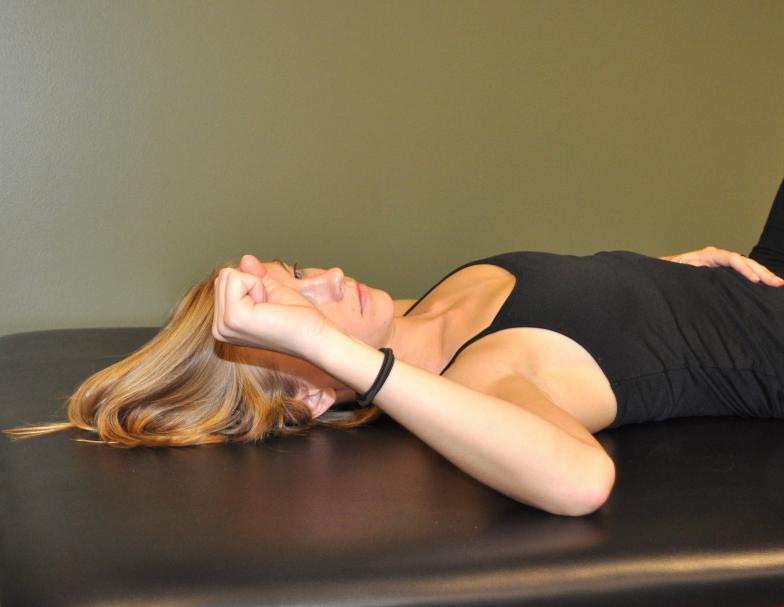
My new regiment, since the three-month follow-up has brought in a few new exercises and modifications of old ones with the aim of increasing both flexibility and strength in all planes of motion. I've been very diligent, and I have seen the returns on my time investment. My internal rotation ROM has improved and is nearing equality with my left side. Also, last night I got my supine overhead ROM to where I can put the inside of my elbow joint up against my ear AND have my forearm touch the ground. Try it, you can do it, but think about not being able to for 100 days!

I've also noticed increases in strength, particularly in the problematic ER plane. Combined with my IR ROM, these two factors will be critical for generating power and achieving proper form on my forehands when I return to Ultimate. I'm working through some eccentric training (negatives) using Therabands, which have proved highly beneficial. Also worth noting, I've been cleared to do all weight training except overhead lifting (maybe another month on that), and although I've avoided it, I am cleared to do some roped climbing, too.

With the adjustments I've mentioned, it's clear I'm back on track. I may have written this before, but I can actually feel the end coming, now. I'll be cleared to play Ultimate again in the next 4-6 weeks, by which time I will be about 20 weeks out from surgery (half a pregnancy!), though full strength won't return for probably another month after that. Unreal. The shoulder really is complicated and while hard work is important, so too is patience. Lesson learned.

Can't wait to see you on the field!

Tuesday, January 13, 2015

10 weeks!

To my dozens of fans and committed readers, I thank you for making it with me through TEN WEEKS(!) of rehab. At this point, I'm ready to start throwing a Frisbee 10 yards with a partner (call me!), and I'm hoping to be climbing by February.

Lita and I decided that because of my rapid progress and most especially my diligent attitude toward my rehab, it is ok to move to one PT session per week. This lightens the load on my wallet, opens up more time at work (I'm back to kicking ass full time without any issues as I do my lab work), and saves my precious insurance-paid PT visits just in case I need them down the line in 2015.

Upon reading the literature on these shoulder recoveries (see earlier posts for these papers) and knowing how my body feels relative to those reports, I believe I am in the final phase of my rehab, which normally is considered to be the 12-16 week period, so again, a bit ahead of schedule. Certainly, I will continue to work hard during the 4-6 month post-op period to build more strength, but I am very close (~1 month?) to reaching the end of my traditional rehab including visits to the therapist's office.

Lita is still holding me back from working my biceps/triceps even though this is typically acceptable at this point in the process, simply because she doesn't want me building any bad habits as far as my motion is concerned. A reminder, the surgery happened 10 weeks ago, but the injury and bad compensatory habits, started years before. We want to rebuild my arm better than ever, and I love Lita's mix of I'm-gonna-kick-your-ass-and-work-you-hard balanced with a be-safe-here approach.

I am just nearly squatting my body weight again, starting light deadlifts, and adding weight to my shoulder lifts (i.e. 8lb prone rear raises, 3lb prone side raises, 2.5lb standing 45 degree raises). A note about my 45 degree raises, Lita started a new manual technique this past Friday do get my shoulder to slide down into the glenohumeral joint, which has helped me with this exercise. No longer does my right shoulder pop/stay up when I lift my arms to the side. The motion is still a little disjointed, certainly not smooth, but the form is there. I should include a picture of this, but it may be too late to capture the previous poor ROM/form.

Just one fully new activity, this week, prone overhead lifts. They are challenging and I can't quite get my arm straight out above my head; as I straighten it, the arm slides out to the side a bit.

Prone overhead lifts

I did advance some of the other motions a little further. My hand is just about getting to the wall in the standing posture exercise. Also, I'm now doing my side plank from a "standing" position instead of from my knees.

"Standing" side plank

You get the idea.

Can't wait to post the next update which will be 12 weeks post-surgery, and leading up to my 3-month follow-up appointment with Dr. Berdia!

Wednesday, December 31, 2014

Eight weeks down & we're rockin'!

Since week six I have made a substantial amount of progress in my rehab, but since the milestones are further apart, I'll likely only post updates biweekly, now. Here are some cool things I can do which most people, myself included - at least pre-surgery, probably take for granted.

-I'm sleeping on my repaired side, although I can't tuck my arm in yet. I still leave the arm extended and outwards, away from my body.
-I can now comfortably reach past my left shoulder with my right hand.
-I can dry my back after a shower by holding a towel behind me and pulling back and forth.
-I can reach up with my repaired arm and grab the top of a door frame, unassisted.
-I can throw a frisbee, backhand & forehand, about 5+ yards! (Heather and I tossed this past weekend. I got about 25 throws in before my arm got tired!)
-I am allowed to back squat with the bar (up to this point I wasn't able to even get my arms back behind my head comfortably to hold the bar in place). Worked up to sets of 135 and felt good.
-I am allowed to carry weights in my right arm, now; arm by my side, hanging, only. This is useful for doing weighted lunges and similar lower body exercises.
-My warmups for therapy no longer start with a heating pad, but on the hydraulic arm bike!
-I am doing strengthening exercises with bands and weights now (See more, below)
-I got a parachute for Christmas and am did a kick ass sprint workout with it, last weekend! I'm also getting my cardio fitness back up. I've worked up to eight minutes at ten m.p.h. on the treadmill (~1.3mi).

And now onto the details, if you feel so inclined to read on.

My overhead and external ROM are 80-85%, and that last little bit is in sight. I started this exercise to get over that last hump of stiffness.


In addition, when I get to the top of my ROM I slide over into the door frame forcing my arm up further. By forcing into the door frame, I can also push my lats & teres muscles back into my body, stopping them from (chicken) 'winging'.

As far as ROM, my internal rotation is also getting much better, and I can do this now.


The winging I mentioned above is already much better as I have already gained considerable strength in my teres/scapula from doing weighted table work. From the position in the first image shown, I have worked up to 3 lb. underhand raises (lifting weight in plane with my body, fingers pointing towards my feet), which hits the rhomboids (image 2), and 1 lb. side raises, hitting the deltoids/shoulder and scapula (image 3a). The added motion with the side raises is to get the thumbs pointed as much as possible up towards the ceiling (image 3b), with the idea of helping rotation within the shoulder joint, which I only have about 50% ability to do.

Image 1 - base position

Image 2 - underhand raises, rhomboids

Image 3a - side raises, deltoid, scapula, shoulder etc.

Image 3b - thumbs up!

More scapula work includes Theraband/tube abduction, and rows.


Abduction

Rows

I'm also working on postural strengthening. This exercise requires a tight core, and arms, elbows, shoulders, back, butt, all against the wall. The trouble I'm having is even though my external rotation in a supine position has reached 80-90 degrees, there is still stiffness in the joint, and full ROM requires assistance by pushing the arm out in that plane of motion. Actively moving my arm against the wall isn't yet possible. Note: I haven't started doing wall slides in the way shown below, yet, although my standard wall slides are becoming much easier and I can now almost fully keep my arms parallel as I do them!

Postural strengthening (left image)
Modification with upward wall slides (right image)

Supine external rotation of the shoulder. When I do my postural strengthening against the wall, this is about as far as I can get my arm, so far.

One of the harder things I am now doing is a side bridge to strengthen the teres major which should help immensely with my aforementioned 'winging'.

Side bridge                                        Teres major

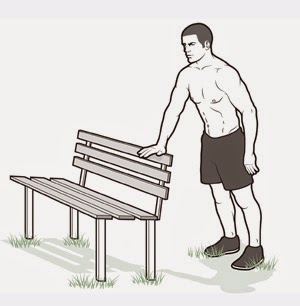
Finally, I'm doing, for lack of a better term, what we call a table lean. The image below is actually meant to demonstrate single-armed incline pushups, but it's the closest thing I could find to what I'm doing. Essentially, I start with both arms on the bench/table/chair in front of me, and alternate between balancing in the 'up' position of the incline pushups, which I'm also using to target the teres, stabilizing the shoulder, but also requires pectoralis, core, and even some groin/glute tightening. What the image doesn't show, is that sinking the hips into the table is required, and the closer the feet are together, the harder this gets to hold.

"Table leans"

So the verdict is, after eight weeks, I'm well into phase III (strengthening), again, ahead of schedule. I'm sleeping better. I feel good. I'm doing sprint workouts now! Everything is doing great on this last day of 2014, and I am excited for 2015 to start. 

Happy New Year!

Monday, December 15, 2014

Six weeks in the books

Few new exercises, which I'll get to, but the long and short of it is: I remain ahead of schedule! Here is a great resource with a clear timeline for rotator cuff repair.  I continue to be at or slightly ahead of the earliest described timepoint for all activities.

Day-to-day improvements:
-I can fully reach my right arm across to my left shoulder, which makes showering and dressing nearly thoughtless activities, again. This resulted, I believe, mainly from the progression of passive activities the therapist is putting me through, laying me on my side and stretching the repaired arm across my body (towards the floor).
-I can put the key in the ignition of the car, and put the car into gear all unassisted with my repaired arm.
-I can put weight onto the repaired shoulder, i.e. when shifting in bed at night, or pushing myself out of a chair/off the floor.

This week we moved into isometric activity in several planes of motion, including adduction, abduction, that is, internal and external rotation, both from the wrist (shown below) as well as abduction from the elbow into the wall. I am also pushing my fist straight towards the wall, and my elbow back into the wall. In addition, I'm doing a full cohort of AAROM with a broom stick as a great warm-up.

Isometrics (top two panels)
"wand" exercise (middle panels)

I am also using a lacrosse ball to work out knots in my shoulder (from the front and back), simply by placing the ball between my shoulder and the wall, and leaning into it, massaging around, etc.

As long as all these additions, particularly the isometric work, go on without a hitch, I will be allowed to continue intensity and frequency and move towards resistance band training, soon!

Sunday, December 14, 2014

The most important progress yet.

Today, I threw a Frisbee for the first time in six weeks!

It was only about a three-yard backhand, and it involved virtually no arm or shoulder movement at all, just a little flick of the wrist, but it felt so good to have a disc in my hand after so long. I did a killer leg workout and took one toss in between each set. It's not a lot, but I'm thrilled, and starting to feel closer to normal.

Tuesday, December 9, 2014

Useful manuscript

Rehabilitation after arthroscopic rotator cuff repair: Current concepts review and evidence-based guidelines

The above links to the abstract for a great review article on the current ideas for treatment and recovery from the type of procedure I had. It should be a free article through PMC, but if there is trouble you can try this link, too, which is directly to the .pdf. The actual text includes pictures of many exercises, some of those I've discussed and some others. It also has an appendix table showing more-or-less when different phases of the rehab kick in. The nice thing is that for anyone reading this dealing with a slower recovery, due to age or complications, there is a timetable for a more conservative approach, as well.

Week 5 summary

Really short post, today, as I leave week 5 behind and start week 6 post-op.

Two modifications of old exercises, and a brand new one.
-Supine scapular retraction becomes prone scapular retraction.
-Front pulley raises adds lateral pulley raises. <-- video link!
-New exercise is internal rotation. Note that this image is NOT exactly what I'm doing, but it does illustrate internal rotation of the shoulder. The idea is to get into position as shown in the second image, on the right, and pull with the good arm, stretching the repaired shoulder into the midline of the body. I use a towel held in both hands to do this. Ideally the hand gets to/past the spine. I couldn't find a better picture of this one as the Google searches all came up with towel stretches in the vertical plane.


Prone scapular retraction


Internal rotation

I've made nice progress in my other activities, though I still have tightness and pain when I'm doing them, especially soreness, afterwards. I am now able to lay on my back with my hands folded on my stomach without the need for a pillow under my right elbow.

Generally, it's still pretty hard, perhaps psychologically more so than physically, with moments of self-reflection feeling as if I'd made some mistake by putting myself through all this. I'm sleeping better but not great, I am unable to focus much at work because I'm constantly thinking about rehab, and I get frustrated with myself, often. However, these weekly reflections are helping as I can see the incredible progress that I have made. I am looking forward to shifting into full AROM and strengthening (phase III) soon.

Tuesday, December 2, 2014

Week 4 update

I continue to remain ahead of the average recovery time. The therapist is being safely aggressive; listening to my body, but always pushing me more.

Now that I'm about a month post-surgery, here are some highlight from week 4:

-All week I was weaning myself off the sling, and I'm now not using it at all, during the day. I only wear it at night, but not to hold up my arm, rather more as a safety net to prevent something stupid from happening.
-Washing, changing, eating continue to get easier. I'm now able to feed myself with my right hand again (surgically repaired side).
-Three new exercises at the start of week 5: Overhead pulleys (it's easy to rig this up yourself w/a quick hardware store trip, or you can just buy a set), forearm wall slides (link is to a great website talking about the usefulness of this activity for anyone doing overhead sports like Ultimate, baseball, and tennis), and hands-behind head scapular retraction. I do this last one laying down, like I'm in the start of a sit up position. In addition to squeezing my shoulder blades together, I am also trying to force my elbows down/in towards my sides. I've got a lot of stiffness in my shoulder and my elbow on all of my exercises stays bowed out because of this stiffness. The new form of scapular retraction is meant to combat this.

Overhead front pulleys

Forearm wall slides (usually done w/both arms parallel)
See video link!

Supine scapular retraction

I'm continuing my lower body & left arm workouts, but it's a little harder to keep up with now that all the shoulder exercises are mounting. It's important to mention how tiring this process is. I woke up from surgery having a repaired shoulder that *will be* better than it was. The problem is getting there. It is an incredible amount of work and very tiring going through all the therapy, even for a serious athlete, like myself. My therapist really put it in perspective for me: Not only am I recovering from the procedure, and the weeks of inactivity in the sling, but I'm also trying to now reprogram my shoulder to use normal mechanisms. For years, before the surgery my body had been compensating for the tears by altering the standard physiological motions, and now, with the new shoulder, I can hit the reset button.

Tuesday, November 25, 2014

3-week update of awesomeness


So many new things! As always, feel free to skip straight to “***big exciting bit” if you want to get straight to the best part of the post.

I have reached the 3-week milestone since surgery. Since having my stitches out I’ve enjoyed the return of a lot of mobility and freedom. A list of all the things I started doing in the past 7-10 days includes:

Showering - mostly without assistance!, though I still can’t use my surgically repaired right arm to wash my left)
Dressing - I have complete autonomy, most importantly being able to easily get socks and shoes on, though it takes some maneuvering of my un-slinged arm.
House work - I can hold light (<5lb) items in my right hand while in the sling. This allows for things like doing dishes to be possible again. It doesn’t seem like a lot, but I was starting to feel bad about all the things I couldn’t help Sarah with around the house.
Yard work - I can use the leaf blower (mostly one-handed), and can rake leaves, although I’m not actively pulling with the repaired shoulder, just lightly holding the rake with the bad arm and pulling with the good one.
Workouts - I mentioned this earlier, but the idea is that at two weeks post-surgery the site of repair reaches a point where it’s much more stable. This allows me to do things like standing squats or left-arm dumbbell press, which before I couldn’t, at least not without worrying I’d be somehow pulling on/activating my right shoulder. Jumping is also possible if I keep the arm in the sling and tight to my side!

My PT is going well, all range of motion progressing, although Friday was a bit of a nightmare. I had a different therapist since Lita wasn’t working that day, and this new lady was essentially apologizing at every manual bit of work she was doing. I was in pretty nasty pain for 24-36hrs after the session, and needed to use a full Percocet Friday night to sleep. Fortunately, the manual work being done on me is not strong enough to risk rerupture, but because I haven’t moved my shoulder in a normal way for so long, reintroducing these motions to my body can be really painful, mostly because of stiffness. Somehow me and this therapist just didn’t click. Word to the wise, *do not* lay and tolerate the pain. Some discomfort is expected, but your body is telling you it doesn’t like some movements for a reason. The ‘no pain, no gain’ attitude is not beneficial, in this case.

***Big exciting bit ---> Lita ‘graduated’ me to assisted active range of motion (AAROM), today. Essentially, lying flat on my back, I’m now allowed to work on external rotation, and overhead motion. I can do this by holding a stick/dowel/broom with both hands. The good arm holds on tight, and the right arm mostly hangs on for the ride, being assisted along the way for the two motions. Here are links to each motion I’m allowed to do, now:

1) External rotation <--video link


24hr update: I’ve done my AAROM work 2x since therapy, yesterday. I already see a substantial improvement in ROM, including the ability to go chest-to-table on my table slides! This is mega-super-awesome progress!!


Also awesome, I am allowed to use the sling without the pillow, now, and can start weaning off the sling at home! Slightly less awesome, tried sleeping without the pillow under the sling, was very uncomfortable, then couldn’t get the pillow back into a good spot on the Velcro attachment and kept waking up with my right hand having fallen asleep. Sleeping well and through the night is still one of the bigger hurdles, but otherwise I’m thrilled about all my progress. Huzzah!

Saturday, November 15, 2014

Excitement and surprise.

Incredible and unbelievable new developments in the past week. Jump right down to the fourth paragraph if you'd like to skip the more mundane, but still useful, details.

I'll first address a few smaller, but still important details. I'm currently through about 11.5 days following surgery. I have been mostly without any Percocet for the past 96 hours. Three of the last four nights I did use 1/2 a pill to help me sleep, as the discomfort is highest and most noticeable in the evenings, particularly when trying to sleep the whole night sitting upright. I've instead taken a few Tylenol during the day if needed, which don't make me drowsy, don't mess with my GI tract, and don't leave me dehydrated and tired. Also, when I came down from nine pills (day 1), to six (day 2), to four (day 3), I definitely felt what I would describe as withdrawal; even lying still in bed, I felt like I was on a boat, gently undulating on the waves.

Every day I also get a little more motion back with a little less pain. My pendulum exercises started at about Cheerios size and are now about 8-12 inches in diameter. In addition, getting in out of my sling, changing clothes, and taking a shower (without getting the stitches wet), have all become increasingly easier. The only crappy part is the sling continues to take a toll on my neck and shoulders, so I unclip every chance I am quietly sitting, and the therapist told be I could to scapular retractions as often as I wanted, which definitely helped the discomfort.

 Pendulum
Scapular retraction

On Friday (Day 10+), I had my third PT appointment. For the first time I started with a heating pad, which felt awesome. This is OK now that the main inflammation from the surgery is gone. Fun fact, day 10-11 is when the movement of type III collagen into the site of the repair is highest, and it will slowly deposit and start to turn to type I collagen as scarring sets in. Additionally, my therapist, Lita, did an incredible job activating my shoulder and doing some shoulder decompressions. I also did a new movement, which I can continue as often as I would like at home, called table slides. These can also be done with the body at a 45 or even 90 degree angle to the table, but I'm not going much past 45, now.

Table slides

The crazy stuff happened after PT. I went across the hall to get my stitches out to find that the middle of the three incisions on my arm was significantly larger than I anticipated. Instead of the standard arthoroscopic shoulder repair, Dr. Berdia had decided to do the mini-open version of the procedure. This did *not* involve detachment of the deltoid, as full-open requires, but does require the central incision is 4-5cm to allow more viewing and a larger portal to work in. The reason for the decision shocked me. As I mentioned in earlier posts, it was thought my supraspinatus had a 6mm full-thickness tear, and my infraspinatus had some fraying. As it turns out, once Dr. Berdia inserted the scope through the posterior incision he saw a TON more damage than he anticipated. The supraspinatus muscle runs under the clavicle and the tendon attaches to the humerus at a site about 14mm across. Apparently, my tendon only had 1-2mm of attachment remaining. The infraspinatus was not much better. At this level of damage, the muscles are barely functional at all.
Two things surprised my surgeon. First, he has never seen so much damage on a shoulder of such a young person. Usually, this level of insult is seen with older patients with chronic degenerative tendon issues. Second, he was impressed that I was able to play (and play pretty well) during the end of the last Ultimate season. Each time I threw a deep huck or pulled the disc, I essentially was risking shoulder dislocation, because of the weakness of the two tendons in questions. Part of their job is to anchor the shoulder in the socket. However, the last 18 months of weightlifting, with specific attention given to strengthening my deltoid and the rest of my shoulder complex (subscapularis and teres muscles) was apparently sufficient to compensate for the underlying injury. So what I thought was a simple stitch up of the one tendon became an intense bit of work that required putting four dissolvable anchors in to reattach both the supra- and infraspinatus. Wow.

Details on anchor placement. Tendon is then sutured to bone via anchors.

Fortunately, the severity of the injury has no bearing on the recovery time. Currently, according to the therapist, my range of motion (ROM) and overall strength are very good. At the end of next week we will start assisted active ROM, and then shortly after that I will leave the sling behind and go to full active ROM, for weeks 4-8. I'll start a heavier strengthening program around weeks 8-12, at which point I'll also be able to return to Ultimate, climbing, and weightlifting. In the meantime I'm getting in some KILLER leg workouts. One-legged skater squats are awesome!

So there you have it. Getting stronger every day!

Thursday, November 6, 2014

Rehab day 1

Just 48 hours ago I was getting home from my shoulder surgery. I spent most of the past two days doing as little as possible and taking pain pills. Today, my routine changed, which welcomed, yet excruciating.

Physical therapy was less than 20 minutes, but it was very demanding. When I first met with the therapist we went over the details of my injury and surgery. She then watched as I removed my sling, making sure I was capable of safely performing this task on my own. Next she took two painful measurements as I was laying down. 1) Extension/lifting of the straight arm from the side, in the direction of the head. Full range of motion is 180 degrees leaving the arm outstretched above the head. I made it to 25 degrees. 2) The far more painful rotation, which was the lateral raise away from the side. Verdict? Intolerable pain at 7 degrees. Damn.

We did one exercise, the pendulum. I was so incredibly stiff while attempting my first unassisted motion post-surgery. It's hard to believe I was throwing 60 yard hucks in the wind just this past weekend. I'll continue to work on pendulum 3x a day until Monday, my next appointment. The good news is the therapist is saying my three month timeline is absolutely within reach if I work hard.


I came home to start this update after rehab, but only made it two sentences before I fell into a two-hour nap. My body is beat and I can feel it. On the plus side I am getting the rest I need, I don't go back to work until Monday, and Sarah helped me take my first shower, today!

Time to start getting that strength back! Do work!


Wednesday, November 5, 2014

Surgery prep, going under, & the first 24 hours

4-5 November 2014
It's done. The first day of my next season of Ultimate started, today. Here are some tips and a bit of info.

First off, as I noted in the last post, the doc originally thought I had a labrum tear, but the MRI showed it was in fact the supraspinatus tendon that had a 6mm hole in it. Well, when he went in to repair it he found another tear, this one in the infraspinatus tendon. (So, the radiologist was right!) Dr. Berdia also shaved out some bone spurs and worked on my bursa, but fortunately found no sign of arthritis! All in all, it was a very successful repair; the surgeon is thrilled with the immediate result, and believes I am off to a great start.

Let me take a step back, here. The day of the surgery, I woke up hungry because of the required fast. That sucked and made me irritable. Pro tip: Try to eat as much as you can, and eat/hydrate until the last minute the surgery prep directions allow.

Also...
- Make sure all services/doctors are in-network, if possible. 90% out-of-network coverage might sound good, but it will likely leave a hefty balance to pay on you own. Fortunately, my insurance has covered everything, so far.

-Getting nerve blocker injected directly into the nerve of your neck sounds awful, but they start dosing you up with goodies before that procedure. Nerve blockers give you that pins and needles feeling all day, but at least they keep the pain at zero for ~16 hours.

-I was considerably more lucid than the last go-around with general anesthesia (wisdom teeth), which of course was the great Nader-debacle of 2009. Coming out of sedation I threatened bodily harm to the surgeon, then started crying uncontrollably, and talked about voting for Ralph Nader 5 years earlier. No adverse effects this time around. I even woke up talking to the nurse about how to potentially cure one kind of lupus (Seriously! Ask me about it).

-I've had a pretty good appetite the whole first day, which is good. It's hard to feel ok taking Percocet with an empty stomach. About Percocet: the suggested dose is two pills every 4-6 hours, but I find taking 2x at a time is only good at night to help with falling asleep. I took two, this morning with breakfast and was too drowsy to do anything for three hours. The physicians assistant and I agreed that taking one pill every 2-3 hours instead should manage the pain without any risk of o.d. so long as I don't greatly exceed three grams, daily, of the included acetaminophen. This is the active ingredient in Tylenol and your liver can't handle much more than that amount in a 24 hour span. 

-On pain management (important!), stay ahead of the pain. The nerve blocker effects tapered off faster towards the end of last night after surgery than I anticipated. When I went to the polls to vote (yup, I sure did!) around 7pm, I started to feel sensation, mostly heat, return to the shoulder, so I took one pain pill. This was a mistake. By 10pm when I was trying to go to sleep I needed two more, but I was already behind the proverbial eight-ball; the next two hours were agony as my pain doubled and tripled before finally coming back down to a reasonable level. I could feel the spots of the scalpel incisions, it was as if they were being filled with molten lava or a hot roofing nail.

The good news is, now a full 24 hours after leaving the O.R., I am managing the pain fairly well, although it is still noticeable; shifting around, standing/sitting is fairly uncomfortable. I am still eating well, icing lots, and getting rest. It has taken me 3-4 sittings to finish this blog post, though, and I've only had enough energy for 2-3 short phone conversations - I feel pretty wiped out, but that is to be expected as my body was put through a fairly traumatic experience. DISCLAIMER, this is a graphic video! Although it is an example of a SLAP tear repair, the first three minutes of the video give a great example of how, even though arthroscopic shoulder repair is much better than open surgery, it is still a major insult to the local tissues!

I do have some gnarly internal images of my own shoulder (pre- and post-repair), which were captured by the surgeon while he was in there, but I only have the prints, and will need to scan them before I can post them, here. Until then, here is a less graphic video (internal camera, only) of what an actual rotator cuff tendon repair looks like, although this, too is not my actual procedure.

That's all, for now. I'll have another milestone, tomorrow as I take off the sling for my first session of PT.

Friday, October 31, 2014

Moving fast

I just returned from the orthopedist/surgeon's office. He did a great job assuaging the fears I had about the damaged tendon. It turns out I may have overreacted a bit. I won't be in the sling that much longer than had the injury been a labral tear, and in fact, he feels generally more confident about the recovery for this kind of procedure. The doc walked me through every bit of my MRI scans, showed me the problem, explained it, and reassured me that there are no other problems in the shoulder. In fact the radiologist noted there might be partial tearing of the infraspinatus tendon as well, but Dr. Berdia dismissed this, which is agreement with what Kris said as well.

So the big news? Surgery is scheduled for...Tuesday! Yeah, I'm going to be under the knife (or arthroscope, I suppose), on November 4th, just four days from now. I'll only miss two days of work and will be doing my first physical therapy (PT) just two days after surgery, Nov. 6th! Four weeks of PT will follow, 2x a week of passive motion, no muscle engagement. Active therapy will follow that.

My initial thought about recovery was, 'Can I beat the 6 month post-surgery landmark', which is where full-strength should be reached. The doc thinks I can be lifting heavy weights and throwing a disc again 3 months post-surgery - the beginning of February! This is undoubtedly great news.

So in a way, this prognosis was the best birthday present I could have hoped for. This, matched with my boss's understanding of the situation, I just got done telling her I won't be able to do an experiment for about a month, has made me feel pretty thankful for the good that is being made of a not-so-good situation. Fortunately, the month ahead at work will be focused on preparing for a big Division-wide presentation, anyway, which would have left less time for experiments, even for a fully healthy version of me. In effect I'm not losing that much time at work. I can still think, write, and talk about my science, and perhaps get a few experiments done one-handed with the help of a few friends, here.

One last hurrah, this weekend (MOSH!), and then it's off to the (recovery) races!

Wednesday, October 29, 2014

Confirming diagnosis & reluctantly leaning towards surgery

I was kind of devastated when I found out about the lack of a labral tear and in its place discovered the tendon tear, simply because of how much more complicated the procedure and recovery will be. In fact, the emotions I was dealing with were probably the main reason for starting the detailed log of my process, because I realized other athletes will go through this and hopefully benefit from my research and experience.

Ok, so the doctor at the imaging facility wrote the report I quoted from in an earlier post, diagnosing the anatomical problem. I also requested to have digital copies of the report and the images, which I showed to a friend who is a hand and shoulder surgeon. It’s always good to get an extra set of eyeballs on your images, no matter what your situation. Sometimes a doctor is looking so hard for one thing he expects he may miss another, I’ve done the same thing as a scientist in the lab with my data. It’s not a disrespect to the orthopedist to ask another one what he thinks, too.

On Oct. 29th, I received an email back from our friend, a hand and arm specialist who trained at the Mayo clinic. He is excellent, but back in Philly/Lehigh Valley and thus too far to be my surgeon on this one. Here is his email reply:
***
Peter.

I reviewed your MRI scan and the report.  I agree that you have a small full thickness tear of the supraspinatous tendon of your shoulder.  I do not see a SLAP tear (labral tear) and agree with the radiologist as well with that account.  The fact is, with these tears, we know that they tend to enlarge with time.  As a younger guy, if the tear is causing pain and discomfort, not allowing you to do what you want or need to do, there is a good reason to fix it and get it over and done with.  The surgery is done arthroscopically, but takes a good amount of time to heal (6 weeks in a sling and then rehab - 3-4 months average).  The other option is to try therapy to make it better.  Therapy will not fix the tear, only surgery can do that, but it may make it asymptomatic.  The tear, while it may become asymptomatic, may enlarge with time becoming more problematic to fix in the future.  

My take on it to patients - partial tear or tendonitis - rehab +/- injection.
Full thickness tear in a younger, active individual - fix it if it is painful.
Full thickness tear in an elderly person - rehab.

I hope this helps.  If you want a second opinion or another guy, I have one in Bethlehem, he’s very good.  Let me know if you need anything else.  

Kris
***
I feel utterly deflated hearing this. I spent a good portion of today not working, but instead obsessing over my diagnosis, hoping I’d find something on the web telling me about some crazy bovine-sperm-derived-growth-hormone method of speeding up recovery. Of course, I didn’t find any such thing, in fact a study shows that HGH doesn’t do anything to help rats over placebo, and can also negatively impact tendon repair at the point of bone attachment. And now, Kris’s email confirms what my research shows. Six agonizing weeks in a sling, 3-4 months of hard rehab afterwards. 

I did find one person who logged some of her experiences with recovery from rotator cuff repair, although she *also* had a SLAP tear and some other minor issues discovered once the surgeon got inside. Essentially the extra problems made the recovery significantly longer. She is an amateur volleyball player and fellow climber.


I am remaining optimistic that my high baseline strength, youth, dedication, and stubbornness will lead to a rapid recovery, although I’m not sure there is much I can do to speed up the original 6 weeks in the sling. We’ll see how well my body handles this. Still have to meet with the actual surgeon.

What I know about the surgery, so far

So the best way to deal with these tears is by surgery. You can live without the repair, as I have demonstarted for the past who-knows-how-long, but to really return to the highest level of function, especially for an athlete, there doesn’t seem to be much other option. The surgery is most successful, with tears that occur 1) in patients 35 or younger and 2) following an acute injury, like the one I described happening to me (layout). There’s a whole host of literature on chronic issues, degeneration with aging, etc, etc, but I won’t get into that. If it tickles your curiosity, again, a simple internet search will reveal tons of information.


The main complications with the procedure (assuming the deltoid does not need to be detached) are shoulder stiffness, and inability to return to full strength. I don’t quite understand the full medical side of this, but then again, based on the literature I scoured, I don’t think the surgeons are 100% clear on it either. Suffice it to say, as I mentioned earlier, the tendon doesn’t get tons of blood flow, executing a correct and tidy reattachment is not trivial, and while younger people are more successful at coming back strong, they are also the most likely to re-tear because they will be returning to the athletics that cause the injury in the first place. Stress for post-operative stress is placed on a high baseline strength prior to the surgery, a strict approach to the instructions of the surgeon (i.e. adhering to necessary rest times), and a regimented adherence to the physical therapy once (~6-8 weeks post-op) active motion is allowed to resume in the shoulder. Disclaimer: any time line I provide is from my own experience and should be used as an idea. Your guidelines from your orthopedist and therapist are key in proper healing. They say not to use your shoulder for 8 weeks? Listen. Please.

Some details about anatomy

The suprasinatus muscle is part of the rotator cuff complex. The tendon connecting this weak muscle to the bone is more problematic to fix, although newer arthroscopic methods have helped decrease recovery time. (It used to be that you’d need to have your deltoid detached during open surgery to access the tendon, but now that can be avoided in most cases). The bad news is the recovery is more in the 6 month range, and full strength may not be restored (i.e. heavy shoulder lifting) for up to and past 1 year. Apparently, this tendon is much less vascularized than many others, is slow to heal, and the technique of sewing the tendon back together and attaching it back to the bone combined with the low amount of blood flow leads to a longer recovery time.


A full-thickness tear (as opposed to a partial-thickness tear) essentially means that there is a hole in the tendon. Some piece has pulled away from the bone but it hasn’t completely ruptured/detached. If that were the case the muscle would have rolled up under my clavicle. Some smaller tears may resolve with rest and therapy, but the full-thickness tear will not. Structurally speaking, the muscle is pulling at the tendon from both pieces of tendon on either side of the tear. That tension along with the size of the tear make it impossible for self-correction. There is some evidence emerging in Canada and the UK about using stem cell injections to encourage regrowth of connective tissue, but it is not approved here in the States.

MRI arthrogram: procedure and experience

On Oct 28th I got my MRI arthrogram done. Here’s a summary of the technique: 

The right shoulder was examined with ultrasound for anatomy and landmarks. Using sonographic guidance and sterile technique, 10 cc of dilute gadolinium (contrast molecule) and xylocaine (numbing agent) solution was injected intra-articularly using a 25G needle (that’s a pretty small needle, don’t worry). The shoulder was lightly exercised and MRI of the shoulder was performed, consisting of axial, oblique sagittal and coronal FATSAT T1W and oblique coronal T2W images using a dedicated shoulder coil on a superconducting high-field magnet.

The whole process took about an hour, although the 5 scans took 2-6 minutes each; I was only laying in the machine for about 20-25 minutes - pretty simple. Here’s where the news was good and then worse. If you want you can skip the paragraph below with the details and go straight to the summary:

Findings: There is no extravasation of contrast into the subacromial/subdeltoid bursa. However, coronal T2W images show a 6 mm full-thickness tear in the distal supraspinatus tendon near the critical zone, this likely represents a small contained a full-thickness tear with scarring. Small partial-thickness articular surface tears are also seen in the distal infraspinatus tendon. The subscapularis, teres minor and long biceps tendons remain intact. No labral tears or paralabral cysts are demonstrated. There is no focal cartilage defect or intra-articular body. There is mild acromioclavicular joint hypertrophy and a laterally downsloping type II acromion. There is type II insertion of the anterior joint capsule. No rotator cuff muscle volume loss is demonstrated.

Summary:
  1. No evidence of labral tears. Yay!
  2. I have a 6mm full-thickness (the full way through) tear of my supraspinatus tendon. Boo!